What is Machine Learning?
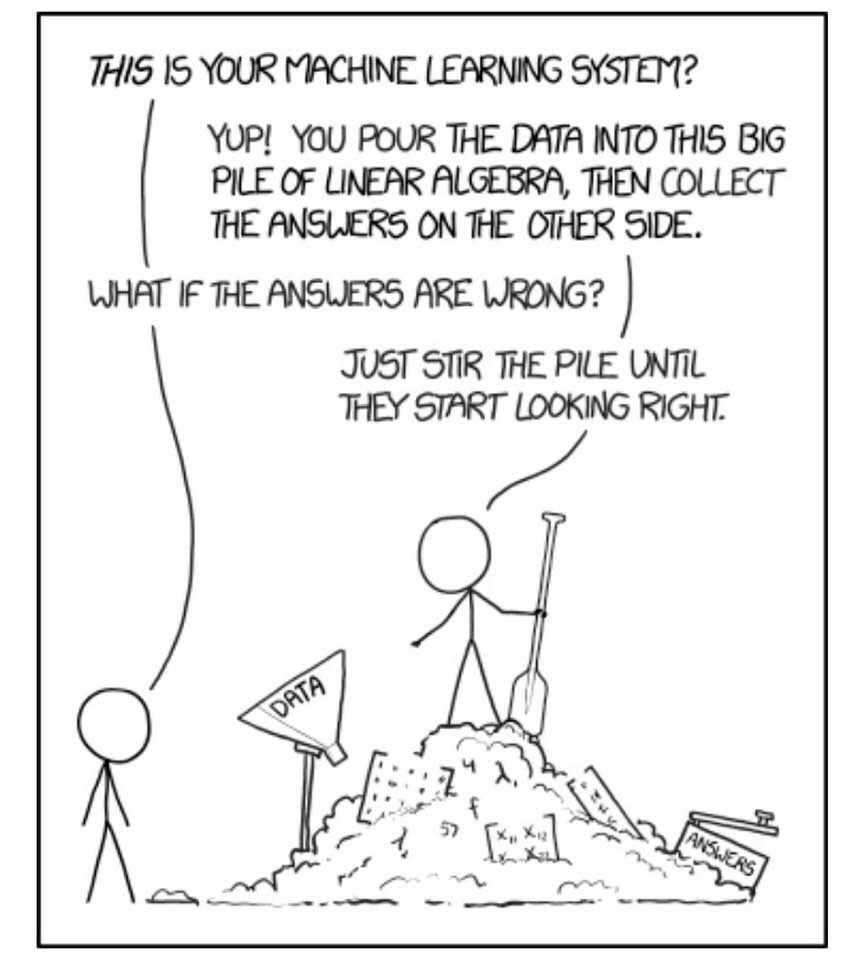
Definition of ML
“A program is said to learn from experience E with respect to some class of tasks T and performance measure P, if its performance at tasks in T as measured by P, improves with experience E.”
(Tom Mitchell, 1997)
Core Concepts

concept |
description |
|---|---|
Model |
a program that generates \(\hat y\) from X |
Model Parameter |
this is what the program “learns” from the data |
Metric |
a performance measure of the model quality |
Hyperparameter |
a number that we have to set before training |
Supervised Learning |
we know the input data X and correct answers y |
Classification |
y are categories |
Regression |
y is a scalar |
Unsupervised Learning |
X is known but y is unknown |
Machine Learning Algorithms
In Supervised Learning we know the correct answers for some example data. The model is predicting an output value \(\hat y\) based on an input X. Supervised learning has two subtypes: Classification and Regression.
In Classification, we want to predict a category. In Regression, we want to predict a scalar.
In Unsupervised Learning we have input data X, and examine the structure of the data without knowing what the outcome should be.
Some ML methods are quite old
method |
year |
|---|---|
Linear Regression |
1805 |
Artificial Neural Networks |
1954 |
Logistic regression |
1958 |
Hidden Markov Model |
1960 |
Stochastic gradient descent |
1960 |
Support Vector Machine |
1963 |
k-nearest neighbors |
1967 |
Decision tree |
1986 |
Random forest |
1995 |
Exercise: Classification, Regression or Unsupervised?
Consider the following five business cases. In terms of ML, are they classification, regression or unsupervised problems?
A) Sales Forecast
To place orders to a factory, you would like to estimate how much of a given item you will sell during the next year. You know how many items were sold per day during the past 5 years. There are 10,000 different items.
B) Credit Card Fraud
You have 100M credit card transactions. Out of these 10,000 turned out to be fraud attempts that have been cancelled. You would like to identify the fraudulent credit card transactions.
C) Driving Assistant
You want to build a device that warns a driver if there is a bicycle on the assistants camera. You have 100,000 camera images on which the bicycles have been labeled manually.
D) Book Store
You want to display potentially interesting books to visitors of your online book store. To do so, you would like to segment your 50,000 customers into groups based on their purchase history, behavior on the website and social media profile.
E) Hotel Reviews
You have 10000 hotel reviews in free text and a star rating (1-5). You have another 10000 reviews for which you have only the text and would like to find out the star rating.
Recap Questions
What is Machine learning?
a) descriptive statistics on big data
b) generic optimization algorithms
c) a computer program that writes other programs
d) optimizing model parameters against
   a dataset and a metric
Which is true about supervised learning?
a) you need data for X but not for y
b) you need data for both X and y
c) you need data for y but not for X
d) you need data for either X or y
How are model parameters derived?
a) from training data
b) from independent test data
c) specified by users
d) randomly generated
What can supervised classification predict? (multiple answers)
a) probabilities
b) category with 3+ possible values
c) a continuous float value
d) binary category