Statistics
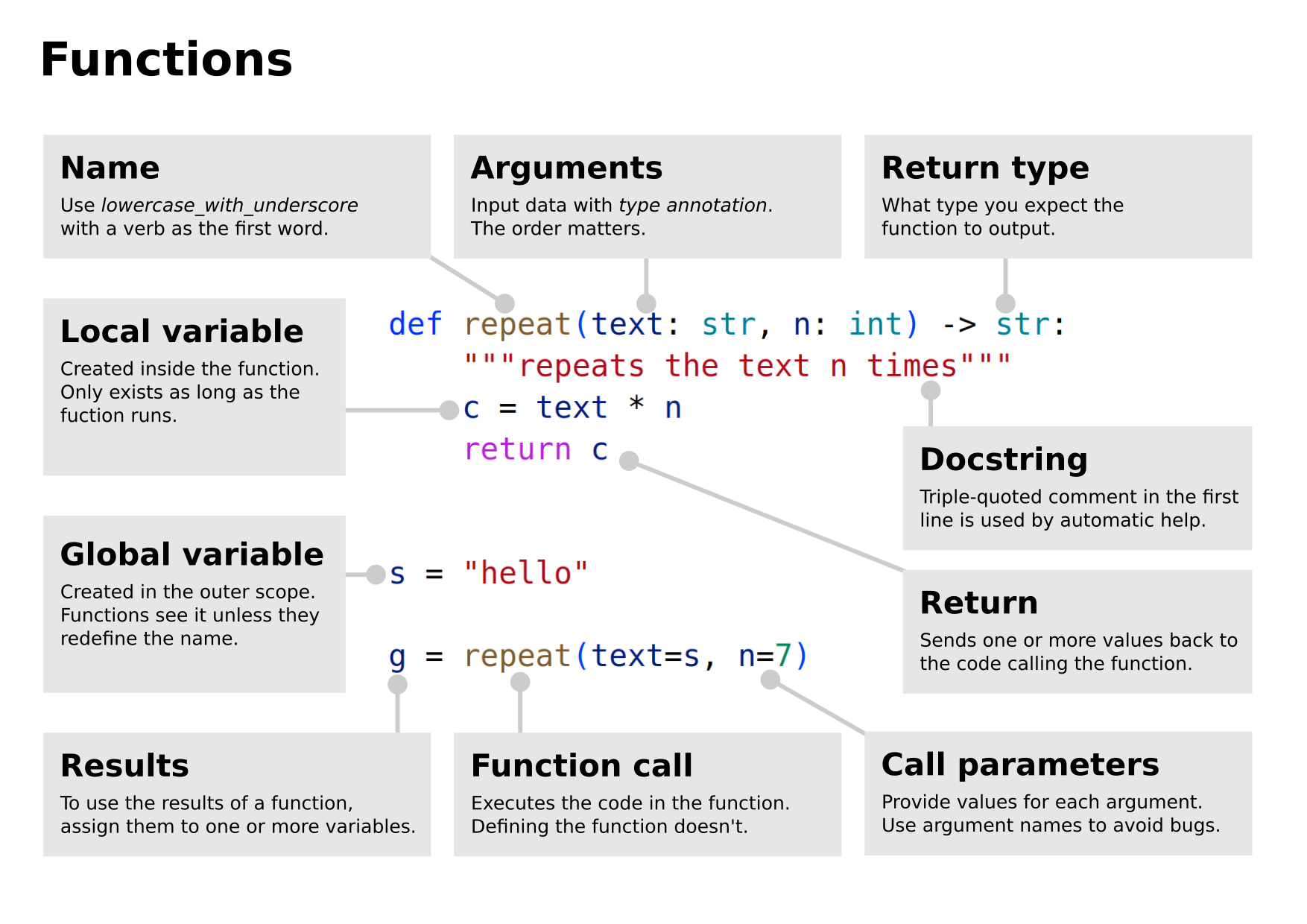
Writing all instructions into a single sequence creates programs that are hard to debug. Here, you learn to break the code down into smaller units: functions.
In this chapter you learn:
area |
topic |
|---|---|
🚀 |
calculate statistics |
⚙ |
implement a function |
⚙ |
call a function you defined |
💡 |
use the |
💡 |
use the |
🔀 |
use a recursive function |
Exercise 1: Sum up
Write a function that calculates a sum from a list of numers. Insert
into the gaps: numbers, data, def, return,
calc_sum',+=`
____ calc_sum(data):
    total = 0
    for n in ____:
        total ____ n
    ____ total

numbers = [12562, 2178, 342, 129, 384, 208, 164, 82, 41]
s = ____(____)
print(s)
Exercise 2: Mean
Write a function that calculates the arithmetic mean from the following numbers:
def mean(data):
    ...

numbers = [12562, 2178, 342, 129, 384, 208, 164, 82, 41]

...
Don't forget about the return statement.
Exercise 3: Shortcut
Simplify the mean function using the function sum().
Use your own or the builtin sum() function.
Exercise 4: Standard Deviation
The following program calculates the standard deviation from a list of numbers. You would like to generalize the code, so that it can be used with other data sets. Wrap the code for the calculation – but not the data – in a function.
import math

data = [12562, 2178, 342, 129, 384, 208, 164, 82, 41]

avg = mean(data)

stdsum = 0.0
for n in data:
    stdsum += (n - avg) ** 2
variance = stdsum / len(data)
stdev = math.sqrt(variance)

print(f"Standard Deviation: {stdev:8.2f}")
Exercise 5: Optional Parameters
Explain the program:
def add(a=2, b=2):
    return a + b

print(add(3, 3))
print(add(3))
print(add())
print(add(b=4))
Exercise 6: Recursion
Explain the code:
def factorial(n):
    """Calculates the factorial of the given number."""
    if n > 1:
        return n * factorial(n - 1)
    else:
        return 1


x = int(input('Please enter a number: '))
y = factorial(x)
print (f"The result is:\n{x}! = {y}}")
Reflection Questions
Why is it useful to write functions?
What do you need to write in a function definition?
How do you call a function?
What does the
returnstatement do?