Indexing and Slicing
Computers and people count differently:
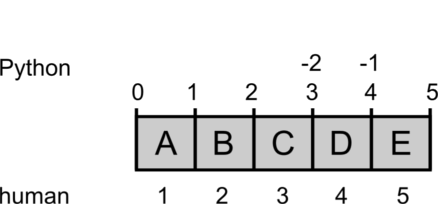
indices for humans and computers
Computers treat an address in memory as the starting point of a body of data. In the same sense, an index in Python always refers to such a starting point, something that is in between two objects in memory. We humans in contrast always count the objects themselves.
This is why the indices used to slice lists are a bit unintuitive at first, e.g. in:
>>> s = "my fat cat"
>>> s[3:6]
'fat'
The diagram provides a practical model by which you can deduce indices yourself.
Indexing
Many data types (lists, strings) allow to index items by their position:
s = 'my fat cat'
s[0]  # first
s[2]  # third
s[-1] # last
Using and index that does not exist causes an IndexError.
Slicing
We can define intervals. This is called slicing:
s = 'my fat cat'
s[3:6]  # -> 'fat'
Slices may be open on either side:
s[3:]  # -> 'fat cat'
s[:6]  # -> 'my fat'
If you leave both number out, you copy the variable. This is sometimes a neat trick, if you want to manipulate a list, but preserve the original.
d = [1, 2, 3]
e = d[:]
d.append(4)
len(d)  # is now 4
len(e)  # still 3
You can define slices with a step size:
s = 'my fat cat'
s[1:8:2]  # -> 'yftc'
s[:8:2]   # -> 'm a '
s[1::2]   # -> 'yftct'
The step size may even be negative:
s = 'my fat cat'
s[::-1]  # -> 'tac taf ym'