Ada Lovelace
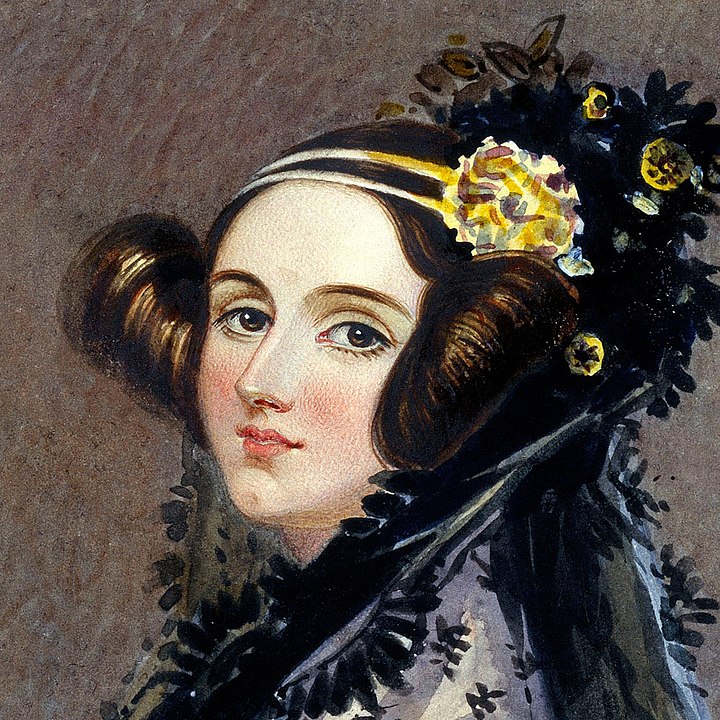
Ada Lovelace, image by Alfred Edward Chalon - public domain
Ada Lovelace was the first human to write a computer program. This was quite an achievement, given that Ada had to imagine a computer first!
In this chapter you will:
area |
topic |
|---|---|
🚀 |
calculate the age of Ada Lovelace |
⚙ |
distinguish data types |
💡 |
use the data type |
💡 |
convert data types |
🐞 |
recognize bugs at runtime |
Exercise 1: Ada Lovelace
Insert the following pieces into the gaps, so that all instructions are
executed correctly: age, int(age), name, str(born),
1815
name = "Ada Lovelace"
born = ...
...  = "37"

text = ... + " was born in the year " + ... + "."
year = born + ...
print(text)
print(year)
Hint
Python contains many functions for type conversion.
With the functions int(), float() and str() you can convert
numbers and strings into each other.
Exercise 2: Nine plus nine
Insert int() or str() into the instructions,
so that all of them run without an error.
9 + 9
9 + "9"
"9" + "9"
9 * "9"
Exercise 3: Output
Which print statements work?
print("9" + "9")
print "nine"
print(str(9) + "nine")
print(9 + 9)
print(9 + int("9"))
print(nine)
print(float("9") + int(9.0))
Exercise 4: Debugging
The following code should calculate the age of Ada in a year entered by the user. It contains three bugs. Find and fix them.
year_of_birth = 1815
year = input('Which year is it? ')
age = year_of_birth - year

print("Today, Ada Lovelace would be " + age + " years old.")
Exercise 5: Age Calculator
Write a program where you can enter the year in which you were born. The program should calculate your age on January 1st of this year.
Use the following code to calculate the current year:
import time

time.time() // (365 * 24 * 60 * 60) + 1970
Hint
time is a Python module. It contains useful functions.
time.time() is a function in that module.
It returns the number of seconds since January 1st, 1970
(called the Unix Epoch, the 0 AD of computers).
Reflection Questions
which variable types have you seen so far?
what does a type conversion function do?
what is a
TypeError?