Create DataFrames
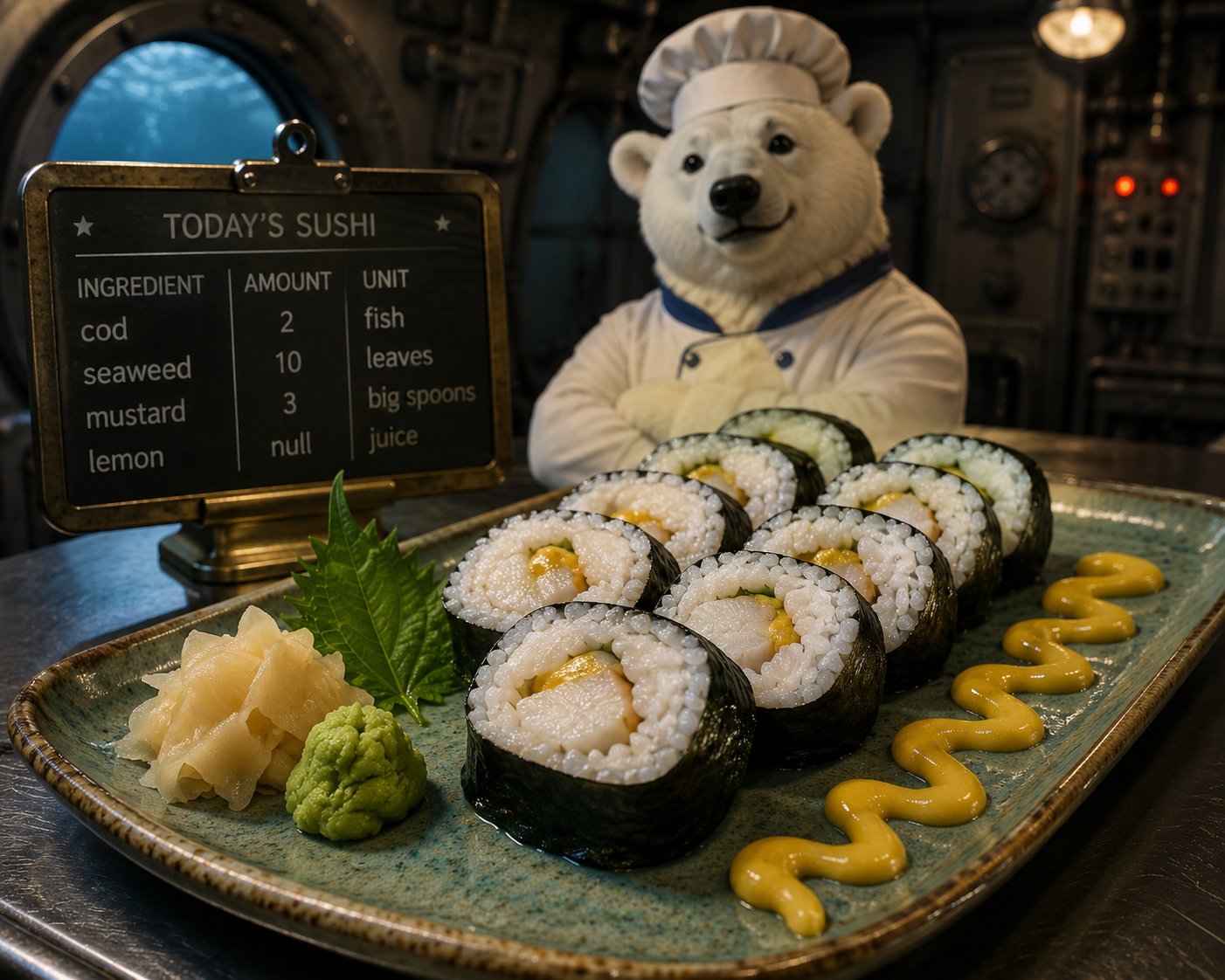
In the galley
Boreaboy, the cook, is according to himself the most important person on the submarine. Or do you think the expedition would get anywhere when their bellies are empty?
Boreaboy is a master of knifes: he slices, dices and chops the ingredients within seconds. Often more than one knife is swirling through the air. Of course, nobody should enter the galley while he is preparing food – it could be dangerous.
He has cultivated the preparation of food into a form of art. Boreaboy even has his own system by which he writes recipes.
Let's see how it works.
In this chapter, you will convert Python data structures like lists and dictionaries into pandas types like Series and DataFrames.
Series from a Python List
Every element of a Python list becomes a position in the Series.
import polars as pl

ingredients = pd.Series(
   ["herring", "onion", "mustard", "pepper"],
)
Optionally, you may provide a data type:
amounts = pl.Series([20, 3, 1, 1], dtype=pl.UInt16)
Series from a NumPy array
NumPy arrays convert effortlessly, because, like polars Series, they have an underlying in-memory data structure. This is especially useful to randomize the recipes a little:
import numpy as np

amounts = pl.Series(
   np.random.randint(1, 100, size=4)
)
What could possibly go wrong?
DataFrame from a nested list
Nested (two-dimensional) lists convert easily to a DataFrame. Adding column labels is fully optional. Here is the recipe for Boreaboys famous cod sushi:
sushi = pl.DataFrame(
    [["cod", 2, "fish"],
     ["seaweed", 10, "leaves"],
     ["mustard", 3, "big spoons"],
     ["lemon", None, "juice"]],
    schema=["ingredient", "amount", "unit"],
    orient="row",
)
You can write the data in vertical direction as well:
sushi = pl.DataFrame(
    [["cod", "seaweed", "mustard", "lemon"],
     [2, 10, 3, None],
     ["fish", "leaves", "big spoons", "juice"],
    ],
    schema=["ingredient", "amount", "unit"],
    orient="col",
)
DataFrame from a dictionary
When using a dictionary, the keys are used as column names, the values are lists for each column. Note that the lists have to be of equal length.
sushi = pl.DataFrame({
   "ingredient": ["cod", "seaweed", "mustard", "lemon"],
   "amount": [2, 10, 3, None],
   "unit": ["fish", "leaves", "big spoons", "juice"],
   })
DataFrame from a Numpy array
Numpy makes it easy to create really huge DataFrames. The index and column names is totally optional, because consecutive numbers are used by default.
import numpy as np

np.random.seed(42)
data = np.random.randint(1, 10, size=(8, 3))
pl.DataFrame(data)
The above numbers are a recipe that Boreaboy used to prepare a huge sushi platter for a celebration with the penguins. To keep his creation secret, all ingredients were replaced by numbers. A day after the celebration, he already had forgotten what the numbers were for.
Create a new recipe.