Group Assignments
Many complex problems are easier to solve in a team. Group assignments help to mitigate the heterogeneity of a class. Besides solving the actual task, your students also train other essential programming skills like planning and talking about code. If they bring different skills, they also learn a lot from each other. Essentially, you want to convert disconnected students:
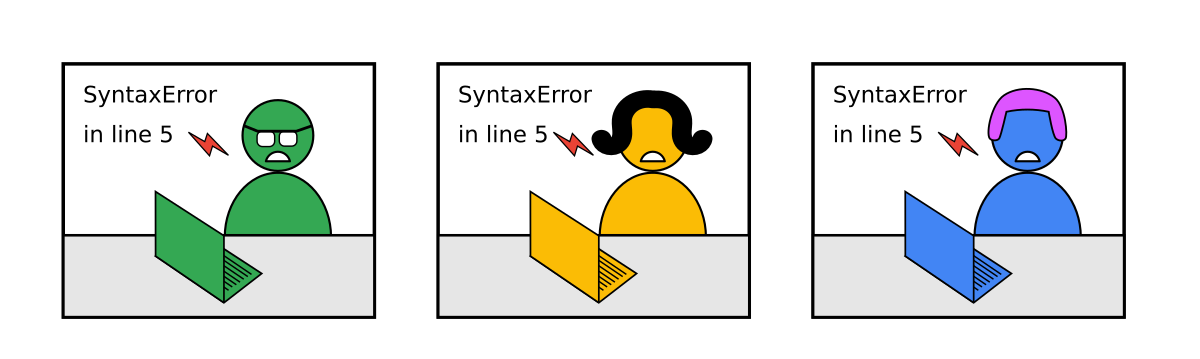
into a group:
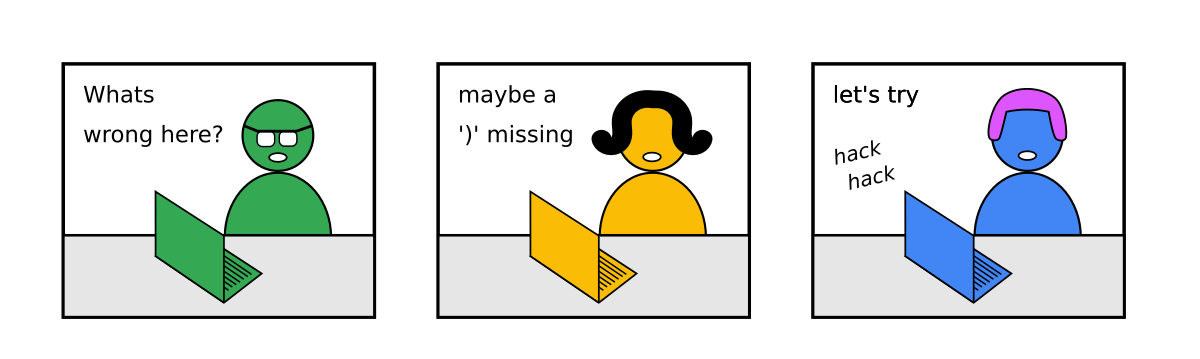
so that:
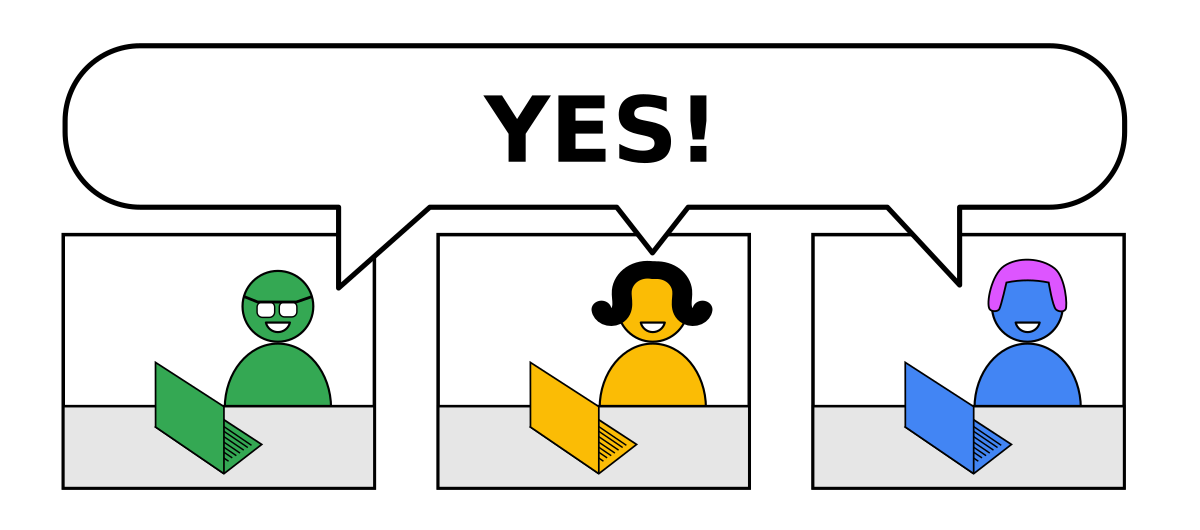
However, unless your students know and trust each other, teamwork rarely happens by itself. It usually requires decisive facilitation from the teacher. Students feel psychologically safe on their own. This creates a barrier that is hard to overcome.
What can you do to encourage students to work together and still feel safe? In most cases, group assignments are a planned, purposeful activity. In this chapter, you will find an overview of different social forms that you could use in a lesson:
Individual assignments
Some students prefer that, because they can organize themselves freely. However, students working on their own get stuck more easily. For you this creates the problem how to find the time to help everybody. Therefore, individual assignments are easier to get started with, but they create a lot of support downstream (the teaching equivalent of tech debt). A few ideas to overcome this problem:
before answering questions, brainstorm problems and collect them on a board
display a students (buggy) code, and debug them together
ask students do discuss code with their neighbour for 10 minutes
There is nothing wrong with individual assignments, but it should not be the only social form you are using.
Work in pairs
This is probably the easiest to organize. Give a task to pairs. Make sure the task is very clear.
Quite often, the chemistry within some pairs will be much better than in others. Some people live on opposite ends of planet programming. It is OK if they keep up appearances for some time while working on their own. Strictly limit the time for pair assignments. This allows you to manage the risk.
Group assignments
There are 3 basic forms to organize group work. Of those, small teams of 3-4 people is the least risky and easiest to organize:
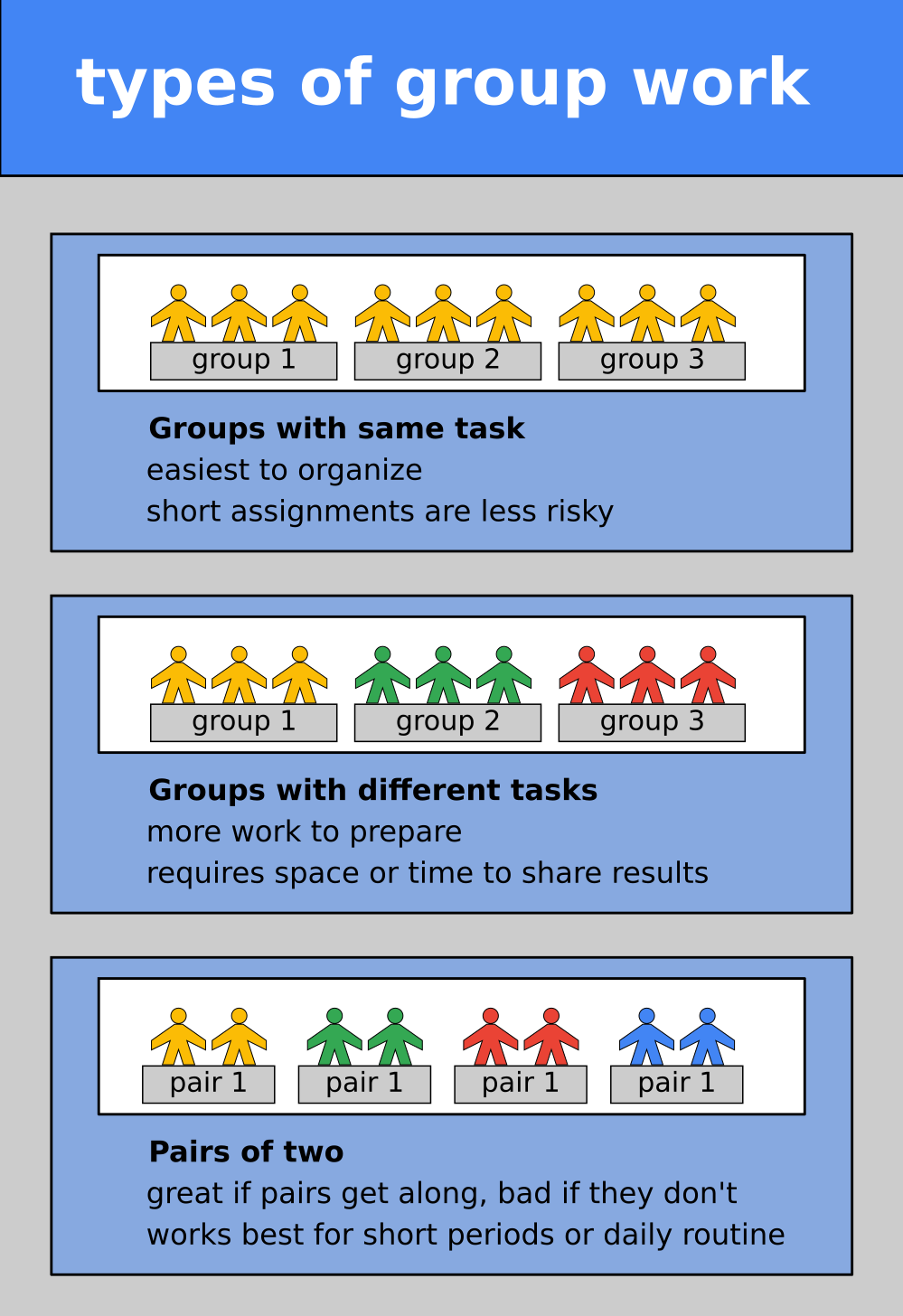
Groups with different tasks are great if you want to cover a lot of ground quickly. Each group could research a different function or library and show something at the end nobody else has seen yet.
Create small groups (2-4 people). Hand out a text or other material. Explain them the assignment, but have it written in the text as well. There are two important variations of group assignments:
all groups get the same task
each group gets a different task
Different tasks give participants more responsibility and potentially superior results. The former is less work to organize and generally safer. Give the same task to each group if you haven’t used this social form a lot.
How to assign pairs / groups
Try any of the following:
use an obvious criterion (location in the classroom)
randomize (drawing colored blips from a bag, using the Zoom Breakout functionality,
random.choice()etc.)Let students self-organize (risky if there are outsiders or tensions in the group; less risky with groups of 4+)
Do not fidget around and try to predict good groups by yourself. You’ll probably get it wrong anyway.
Explain the task first
In any group assignments, it is essential that you stick to the following procedure:
Explain the task
Answer question to the task
Assign groups
Share material (handouts etc.)
As soon as you assign groups, the students will start to focus on each other. As soon as you share material, they will want to examine it right away. Both draws attention away from you – which is exactly what you want. But they won’t listen to you any more, so make sure to tell them the group what they are expected to do. Otherwise the result will be a big mess.
Check the technical setup
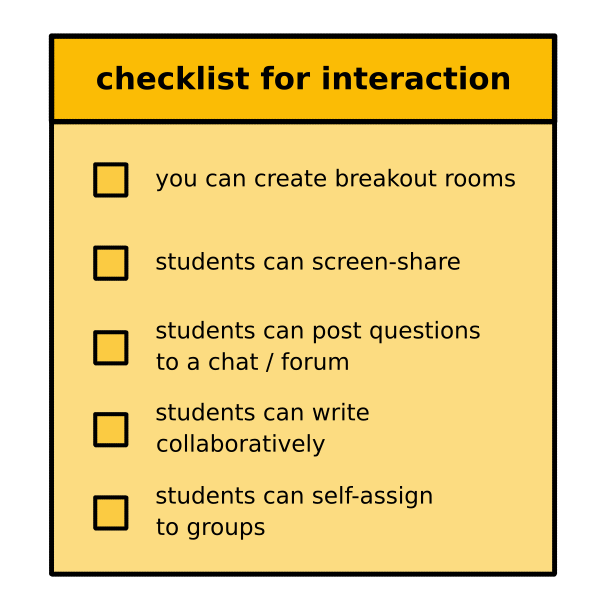
checklist
An class is very sensitive to little bumps. If something does not work out it takes the momentum from group activities. In an online class, this is even worse. So you want to make sure that technological setup does not get in the way.
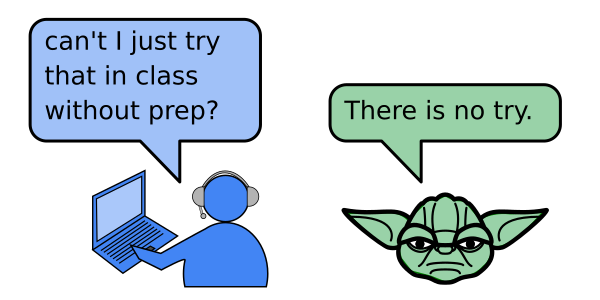
Establish rules
When I started to teach online, I realized that rules for tasks and activities need to be more clear than in a classroom. The last thing you want is that you have 3 students in a breakout, each with a different opinion on what they are expected to do. To be clear, put the following information in the eyes AND ears of your students.
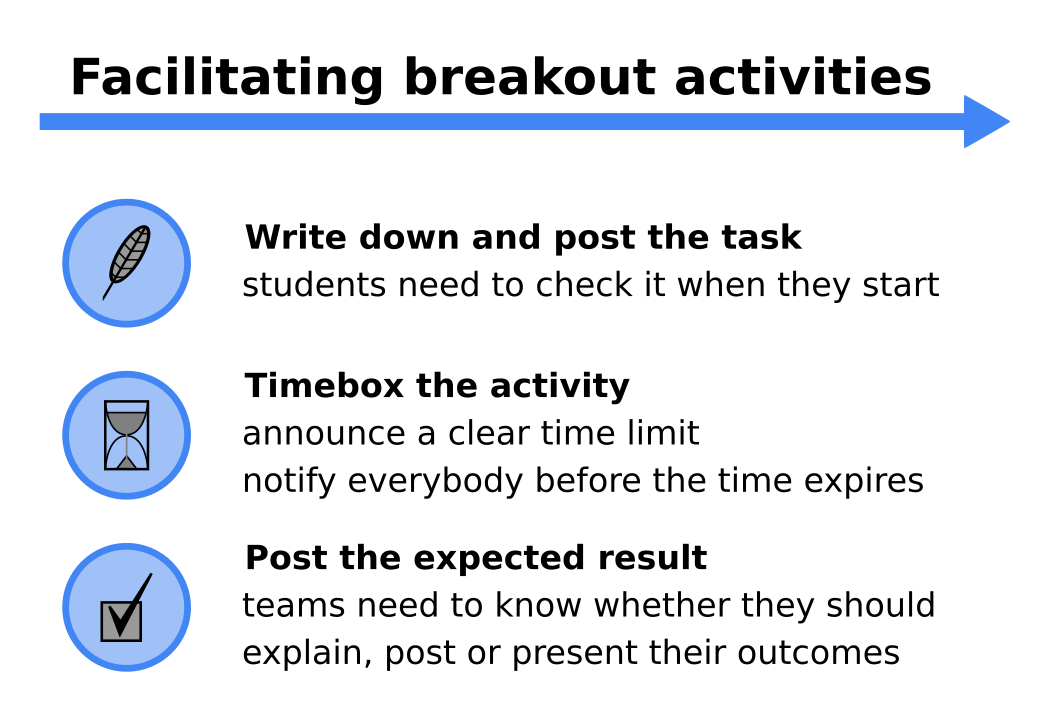
A good example of a group task that you could post to a chat would be:
Hyperparameter Optimization of a Classification Model
-----------------------------------------------------
During the next 25 minutes, your team should:

1. Open the notebook `titanic.ipynb` that contains a Logistic Regression model
2. Add the GridSearch example from the lecture notes
3. Train the GridSearch to find the best hyperparameter value for `C`
4. Post the training and test score to Slack
Example Tasks
Here are typical tasks that are not too difficult to prepare:
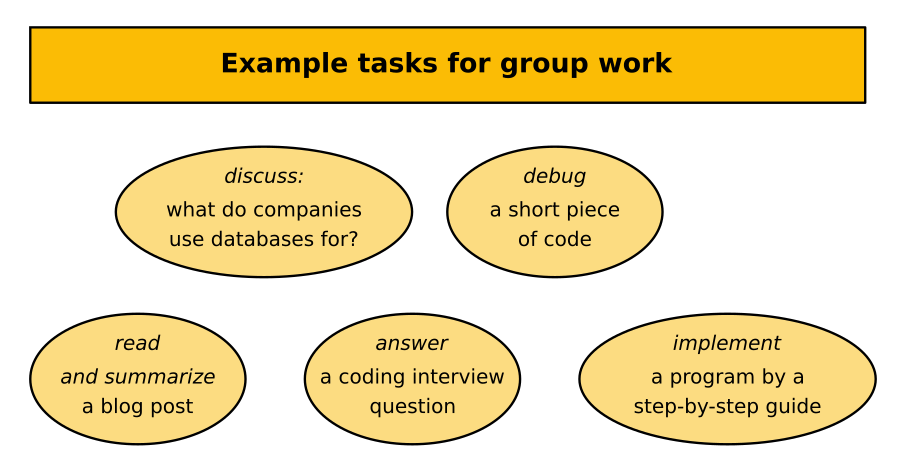
Notes on the timing:
discuss an open question: 2-5 minutes, good for warming up
debug a piece of code: 5-10 minutes
read and summarize: 15 minutes (blog post) to 90 minutes (research paper)
answer an interview question: 5-10 minutes
implement a program with a step-by-step guide: 20-60 minutes
During the longer tasks you can go around and see if anyone wants help or take turns reaching out to the groups via a chat.
Easy wins
When you prepare tasks for group activities, make the task a bit too easy. First, tasks are usually more difficult for the student than one would think. Second, you want to lead your groups to success. It is utterly frustrating if none of the groups makes it to the finishing line or if your group is the only one that fails. Third, you maximize the benefit from working in a group. If the core task is easy, your advanced students will have time to try and discuss alternative implementations. This is exactly where you want them to be.
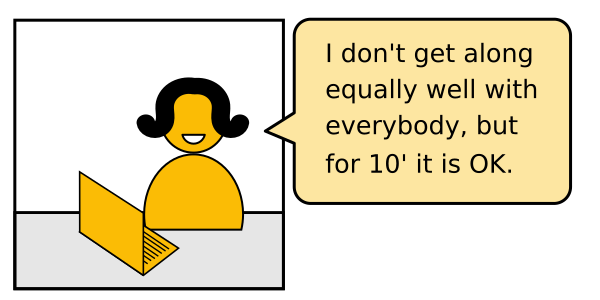
If you do not have much experience with group tasks or need to get to know a group of students, start with a shorter task (up to 10 minutes). Shorter tasks are psychologically much safer:
Caveats
These tips make student cooperation more likely. It still strongly depends on the group chemistry at a given moment. Some groups take up your encouragement very eagerly, others won’t react at all.
If it does not work it is not your fault. Imagine they have 2 kids or 7 cats around while being in your course. Such situations do occur, and sometimes you won’t notice.
But celebrate if it does work!