Facilitating Coding Exercises
If your participants need to do something, they need instructions that are clear and that they have a good chance of completing themselves. An example that does not work well with beginners:
Implement the quicksort algorithm.
There is a big problem with this type of task. It does not contain a clear problem-solving strategy. When learning a new concept (the sorting algorithm), it is very difficult to develop a problem-solving strategy simultaneously (see Greg Wilsons book for a detailed explanation). The result is cognitive overload.
An example that might work better is providing a working path:
1. Complete the quicksort code using given code sniplets.
2. Execute the code on the datasets A and B.
3. Measure how long the program takes to complete.
4. Compare the performance to Pythons built-in `sort()` function.
In this exercise, the students have a chance to execute, analyze and understand the quicksort algorithm before having to implement the whole thing.
In this chapter, you will learn several strategies to design coding exercises that reduce the cognitive load.
Step-by-Step tutorials
Probably the easiest way to facilitate a practical exercise is to write down every single step necessary to complete a task. Most of the time the tutorial is telling the participants exactly what to do, which lines of code to write etc. If they manage to follow the recipe, they will probably succeed. This is a good approach for longer exercises, because students need to read and implement each step carefully. Step-by-step instructions let students proceed at their own pace.
If you want to see a highly developed step-by-step guide, take a look at the Django Girls Tutorial. This piece has been tested by more than 10000 people. Yet, Django Girls keep a high number of coaches around at their events, because most of the participants are total beginners and the tutorial covers a wide range of technologies.
On the positive side, step-by-step exercises keep the class busy and allow you to focus on matters where your full attention is required. Also, they lead to success for most participants quickly. On the other hand, following a step-by-step guide is not very challenging for advanced students. As a participant, you are aware that you are following a “safe path for tourists”. This could limit the learning experience. Also, reliable step-by-step instructions need time to prepare. Python installations, environments, missing libraries or a simple typo in the the instructions will require your help.
Concluding, step-by-step tutorials are a useful method for a first confrontation with a new technology.
Reduced examples
Writing a program from scratch is difficult. It works better to provide a reduced example. A reduced example means that you prepare an incomplete solution. The incomplete solutions puts an otherwise difficult problem in arms reach of your students. To create a reduced example, create a complete solution first and then omit or mix some parts:
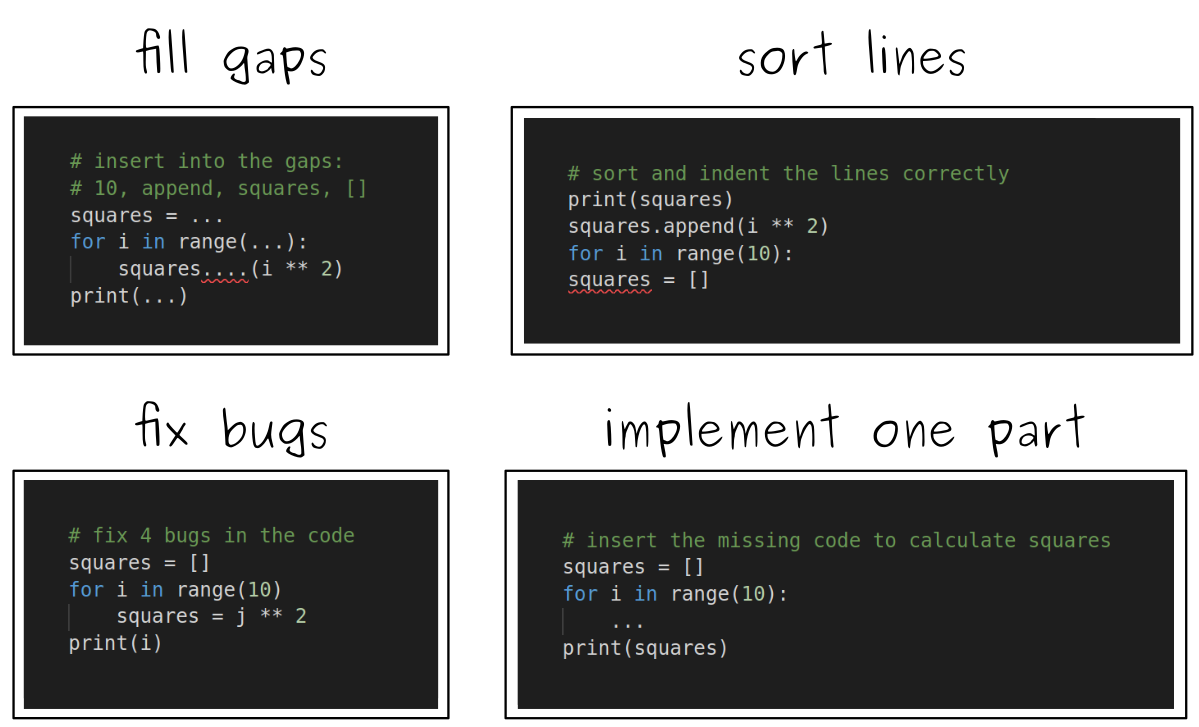
method |
difficulty |
|---|---|
step-by-step instructions |
easy |
code with gaps |
easy |
sort code lines |
easy |
sort code blocks |
easy |
fix unindented code |
easy |
solution with bugs |
medium |
pseudocode |
medium |
empty function headers |
medium |
problem only |
hard |
Reduced examples can be used in many situations:
a 5-minute puzzle that helps you to introduce a new concept
a longer exercise where students need to apply something you explained earlier
repeat something that you did the previous day
Reduced examples are great because you can fine-tune difficulty.

Reduced examples allow you to recycle code examples from earlier lessons. It saves a lot of time if you slightly modify an exercise you know well to adapt it to a specific audience.
Taken togehter, reduced examples are a powerful technique that spice up a lesson and trigger interesting questions.
See also
Faded Examples by Greg Wilson.
Programming from a model
Instead of giving a prose description, you can describe the problem using a formalized description or model. This is more difficult than a reduced example, but less difficult than starting with a prose description alone. Ways to describe your model include:
Flowcharts
ER-models
UML Class diagrams
UML sequence diagrams
State diagrams
Parnas tables
graphical descriptions of an algorithm
Self-checking exercises
A very valuable type of exercise is where participants can assess their progress themselves. Sometimes it is sufficient to get the code to execute. This works well if the program draws an image:
Write a program that draws the flag of Italy.
or when the students are writing a game:
Implement a rock-paper-scissors game.
But getting the code to run is insufficient or outright dangerous, when miscalculations or other semantic defects is go undetected easily (e.g. in data analysis or machine learning).
In these cases, your participants need a way to validate the program or to assess intermediate steps. There are a few good options:
provide sample output at each step (“The output should look like this”)
use a test dataset or introduce the concept of validation data early on (in machine learning)
provide
assertstatements or Unit Tests that participants can follow alonghave each step result in a character, the characters form a word at the end
create a whole framework for self-checking code (probably a lot of work). The Python Koans by Greg Malcolm are a good example of this approach.
Such exercises are valuable but more costly to create. Not only do you need to think of the problem itself, you also need to create a mechanism (or multiple ones) by which participants can assess their progress.
Example:
In my bash tutorial, every exercise results in one or a few characters that form a word:

Once a student discovers that word, it will be self-evident that this is the correct solution.
Exercises with self-assessment are inspired by the Montessori school of teaching.
Knowledge transfer
Show a sample solution for a related problem first.
When reading a language coursebook, you will find at the beginning of each chapter a short text that contains examples of all topics treated in that chapter. Lessons usually start with reading this text, and then elaborating different aspects of this topic (grammar, vocabulary, content etc.).
You can borrow this idea, and apply it to teaching other subjects, too. First, you show a sample solution, and let the trainees repeat and understand it. Then, you give a task where trainees have to modify the approach a little to apply it to a different problem. Provide some reference material (data, facts, formulae, computer commands etc) that trainees can work with independently.
What is very nice about this method is that you can fit complicated subjects into a shorter time box, because the trainees don’t have to start from zero.
Optional hints
Build a fail-safe system into tutorials or other complex tasks.
Create an incremental set of hints that guide students through an exercise. The hints can be on paper cards or on a wiki webpage. The hints do not replace giving a theoretical background or providing an overview of the topic. They rather help trainees regulate their learning speed autonomously, thereby taking the burden off the trainer to intervene when small problems occur or getting interrupted.
This method is described in more detail in:
Rother K, Musielak M, Pleus A, Upmeier zu Belzen A, Multi-Stage Learning Aids applied to hands-on software training. Brief Bioinform 2010; doi: 10.1093/bib/bbq024.
Early Victory Strategy
Let your participants know a goal that they can achieve easily.
When working on course projects and longer programming assignments, set the threshold low. Communicate a main goal that the average student completes in 25% of the time allocated for it. Add a few optional goals:
Main goal:
* implement the Fizz-Buzz-Test

Optional goals:
* let the user input the maximum number
* implement the code as a function
* do not use any variables
The purpose of this approach is to let your students build their own self-confidence. Feeling more comfortable, they will find it easier to cooperate as a group. Also, they will find the room to find unexpected solutions.
I have used this strategy with great success in 10 consecutive course projects in a full-time course. The main assignment was:
Give a 5' lightning talk about a topic of your choice on Friday.
The result was that students found very diverse topics while working on their course projects. A side effect was that the lightning talk sessions became a lot more enjoyable than hearing a dozen similar project presentations.
Source: The early victory strategy is based on the teaching of Sun Tzu.