Selling your Lesson
To make adults learn, they need to be convinced that they have come to the right place. I call this convincing “selling the lesson”. You have to sell your lesson even if the students are not paying or have already paid. In an IT course, lessons are not that hard to sell, because students usually really want to learn. However, they still want to know why they should be in your specific lesson.
Yoda sells a lesson
Sell your lesson in one minute
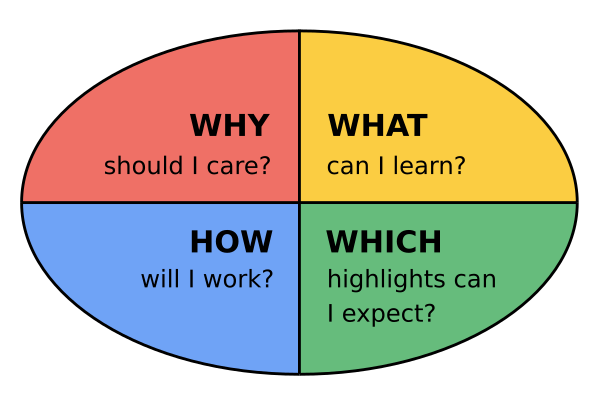
4Mat - questions to sell your lesson
An easy strategy is to answer four questions in the beginning:
Why should I pay attention?
What is the lesson about?
How will the lesson take place?
What highlights can I expect?
A one-minute technique for expectation management is to answer each of the four questions briefly. This way, you address the needs of all participants. Planning for the answers help you to construct an interesting lesson.
For a lesson on time series forecasting, your introduction could be:
Welcome to the lesson “Time Series Forecasting”.
Today we will forecast bicycle rentals.

Time Series are super common. Every business has time series data
and wants to know what the future brings (WHY).

In this lesson, you will learn to train a Poisson Regressor
and take care of seasonality in the data (WHAT).

In the first half I will go through a scikit code example.
In the second half you will work in teams to apply
a few new pandas functions on the data. (HOW)

We will use plotly to create diagrams,
because it is my favourite library (HIGHLIGHT)
Note
4-Mat is a method attributed to Bernice McCarthy, 1979.
Selling your lesson in 7 minutes
Sometimes you would want to go into a bit more detail, e.g. at the beginning of a longer course or when you need a buffer for people to arrive. A more detailed sales pitch could cover the following seven points:
Utility
show value (personal, job, organization)
Product
show a goal for the training
Process
describe your approach to training
Objectives
activity (not ability): “at the end of this module you will show/demonstrate/explain/draw/build X.”
requirements: “volunteering, time, randomize, all/some”
expected degree
benchmark/method
Justification
Source of your information
Build credibility
Provide evidence of previous success of the subject/method/yourself
Review
emphasize critical points softly, restate utility.
Source: Jolles. How to run seminars and workshops