Planning well-balanced Courses
If you design a longer course, you probably not only want to cover a range of topics, but also have a balanced mix of objectives. In this chapter, you learn about Blooms Taxonomy, a powerful model to organize a larger set of learning goals. looms Taxonomy categorizes learning goals into a hierarchy according to the activities participants perform. These activities range from basic to more complex activities over six levels:
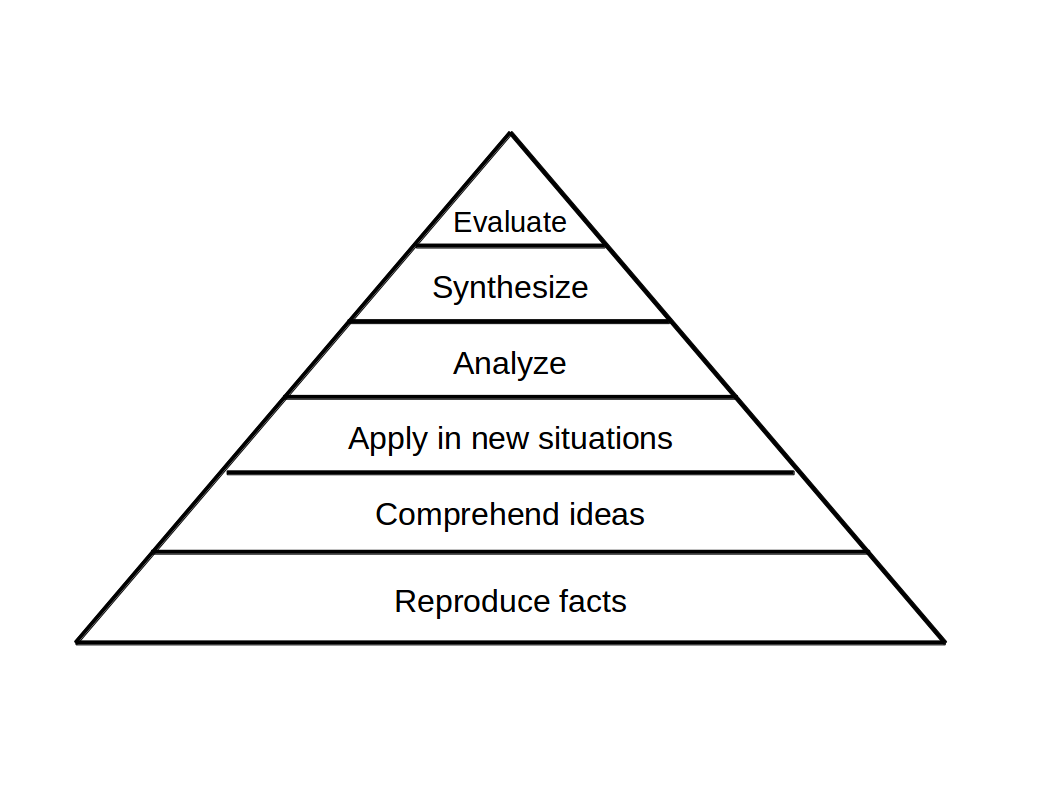
Applied to a lesson on for loops, you could formulate the following goals:
level |
activity |
example goal |
|---|---|---|
1 |
reproduce |
identify correct syntax of a for loop |
2 |
comprehend |
explain a for loop drawing multiple squares |
3 |
apply |
write a for loop drawing squares in different colors |
4 |
analyze |
review different implementations of loops |
5 |
synthesize |
refactor repetitive code using a loop |
6 |
evaluate |
discuss advantages and disadvantages of for over while |
Ideally, a course has a mixture of activities. As the pyramid in the figure indicates, the majority of goals in a course should be on levels 1 + 2, a smaller number on levels 3 + 4, and a few on levels 5 + 6.
Blooms taxonomy helps you to focus less on content and more towards practical skills programmers need. In the table below, you find verbs that you can use to create activities.
|
|
|
|
|
|
|---|---|---|---|---|---|
define |
describe |
implement |
debug |
plan |
advocate |
identify |
explain |
execute |
compare |
design |
defend |
enumerate |
draw |
calculate |
differentiate |
plan |
recommend |
name |
illustrate |
estimate |
examine |
refactor |
judge |
recognize |
classify |
measure |
investigate |
organize |
assess |
quiz |
summarize |
demonstrate |
test |
discuss |
suggest |
You will quickly notice that some topics are more apt for one or other type of activity. Also, you could make an activity on each level more or less difficult. So, by combining topics, activities and difficulty, you have practically an infinite number of goals for a lesson.
See also
Bloom, Taxonomy of Educational Objectives Handbook (1956) and LeBrun and Johnstone (1994:162).