Programming is difficult to teach

Teaching is a very old profession. A lot has been written about theory and practice of teaching. Reading a book on education is a good idea. However, teaching programming is special. There are specific challenges that many programming teachers face. In this chapter I would like to point out five of them.
Programming is difficult
Consider you are teaching an introductory Python course. As a classroom project, your students are going to analyze a tabular file with penguin data. You would like them to write a small program like this one:
# count all Adelie penguins
ade = 0
for line in open('penguins.csv'):
    if 'Adelie' in line:
        ade += 1

print(f'There are {ade} Adelie penguins in the file.')
What difficulties do students face when writing such a program? Here are a few things many beginner programmers struggle with:
set up their Python environment
decompose the problem into elementary steps
understand the abstraction behind the for loop
combine the for loop with a conditional statement (two abstractions)
type in the instructions correctly
find out the correct path to the CSV file on their machine
In all these steps, details matter. Getting one tiny detail wrong usually ruins everything. In this aspect, programming is fundamentally different from e.g. a spoken language. This is enough to make programming difficult to learn.
Debugging is even more difficult
Most learning resources like books and training videos focus on writing code. But this is not the hard part! Consider the following variation of the penguin counter program:
# count all Adelie penguins
ade == 0
for line in 'penguins.csv':
    if line in 'Adelie':
        ade + 1
        print('There are {ade} Adelie penguins in the file.')
Each line of code contains a bug that breaks the program. Most of them are hard to see and likely to get first-time programmers stuck. Understanding why a particular line is correct or wrong requires a lot of context (syntax, other lines of code, input data, function signatures etc.). A student of programming needs the entire context to make a program work. As a teacher, you not only need to teach the (already abstract) instructions your students see on the screen. You also need to teach them the skill of debugging, where you need to think about abstract things that are invisible.
Programming requires multiple skills
To count the penguins in Python, you could also use pandas, a popular Python library for data analysis. Essentially, pandas allows you to process tabular data without control flow statements:
# count all Adelie penguins
import pandas as pd

df = pd.read_csv('penguins.csv')
adelie = df[df['species'] == 'Adelie']
print(adelie.shape[0])
This program still counts penguins. But which of the two penguin counter programs is better? The earlier program with the for loop uses only basic language features and will work in any Python environment. It is easy to understand for anyone who used a different imperative programming language before. The second program using pandas gives your students a powerful data analysis tool. On the other hand, the extra library needs to be installed and creates a long-term dependency for the project. Also, pandas code is not always easy to read, and the students will learn nothing about control flow.
Professional programmers face decisions between alternative approaches all the time. So, in addition to writing code, they also make design decisions. Making design decisions is an important skill that is orthogonal to writing code. In the table below you find more such skills (competencies in educational jargon) that programmers typically use:
skill |
description |
|---|---|
write code |
decompose a problem into programming instructions and type them in |
program design |
make decisions on structure, algorithms and technologies |
reading code |
understand other peoples code, including your former self |
debugging |
diagnose errors and fix them |
refactoring |
improve the structure of your code |
development tools |
use an environment to work with code efficiently |
testing |
check whether a program is doing what its inventors had in mind |
validation |
check whether the program contributes to its purpose |
version control |
keep track of changes over time |
algorithms |
know problem-solving strategies |
communication |
explain code and software projects to other people, including non-programmers |
If you don’t know these skills exist, it is very difficult to learn about them on your own. Yet, most introductory programming books and courses focus entirely on the skill of writing code. What about the other skills? Can they be taught? Yes, of course, all of them can be taught. But it is difficult to find the right balance of skills and to communicate it clearly. But in my opinion, teaching programming is all about finding that balance.
Note
A senior programmer might comment that both implementations are bad, because there are no tests, bad documentation and the scope of the program is not defined. testing, documenting and requirements engineering are more skills a programmer needs.
Content is unstable
I once had the pleasure to attend a meeting of math teachers at a primary school. The teachers discussed strategies to work with students who struggle with integer arithmetics between 1 and 20. One of the teachers pulled out a box full of cards with exercises. Each card was tailored at a specific sub-problem (e.g. adding 9) that the teacher could briefly explain to the student and then help the rest of the class. I was genuinely impressed. The material addressed a teaching situation that all of the math teachers had experienced. The cards had been purchased from a publisher that specializes on that kind of material. I realized that it has advantages when about a million students learn the same content each year. The arithmetics between 1 and 20 are very stable. The content (syllabus) for primary school math is defined completely and in detail. Unfortunately, this is not the case for programming.
There is no universally accepted, generic content for programming languages. Practically, every teaching institution uses their own. You can expect that your course or tutorial will have to be uniquely structured from scratch. Crafting content covering the many skills of programming is not easy. To make matters worse, the technologies we work with evolve rapidly. Whatever you create, will have to be regularly reviewed, refined and updated.
Skills grow non-linearly
Note
“Things that took me 2 days a year ago now take me 10 minutes”
(anonymous former course participant)
non-linear skill growth
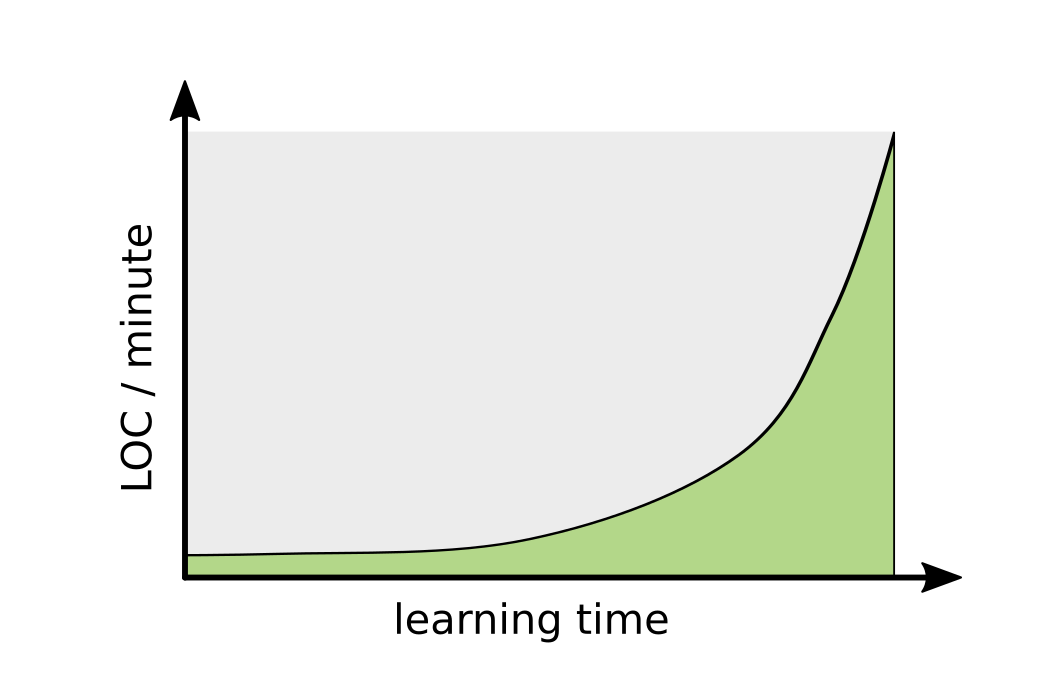
People learning to program often progress impressively. A few weeks of experience enables the same person write similar code 10x faster or solve problems that seemed insurmountable. My impression is that this steep learning curve persists for a long time (see the fictional curve in the figure). Practically it means that most programming classes will be highly heterogeneous in the skills of students.
The heterogeneity and lack of a metric create a perception bias: one student has the impression that another student is much more advanced, when they really are only a couple of days apart on the same learning path. This perception bias promotes all kinds of side effects like impostor syndrome and can generate a lot of stress. As a teacher, you need to divert energy from the frustration this creates.
Students would benefit from locating themselves on the learning curve. However, there is no straightforward metric for programming skill (such as the time for running 5 km) or a benchmark system (like the A1, A2.. C level system for learning languages). Most of the time, the emerging programmer is in the dark where they are on the path to mastery.
In my opinion, the better alternative is to embrace the diverse experience of your participants: The goal of a course is that after it the students are programming better than before. If this is your goal, you create education where everybody wins.
Summary
From these considerations, it should be clear that programming is difficult to teach. Which means that the job of a programming teacher is interesting. Let’s take up the challenge and see how we can approach these challenges systematically.