Getting to know each other
Most participants appreciate when you address them by their name. Knowing each other has many benefits: It creates a good atmosphere, it gives you information early to fine-tune your lessons (e.g. their expertise), and gently shifts the group into the right mindset for learning. But this puts you in a difficult spot: Your participants usually outnumber you, and memorizing all the names is hard work.
Should you learn the names or not?
You have four options how to deal with the names of your participants:
Don’t care about names. Do this when your audience numbers more than 30 people and you won’t see them for longer than a day.
Provide name tags. Do this, if the group is less than 30 people and it will take time to memorize them.
Do an introduction activity. Do this if the group size is 15 or lower.
The introductions should be short to avoid the impression that you are wasting time playing games. As a rule of thumb, use the table below.
setting |
duration |
|---|---|
one-time lecture |
- |
half-day training |
<5 minutes |
one-day training |
<15 minutes |
one-week course |
30 minutes |
longer course |
up to 1 hour, possibly split to multiple sessions |
In this chapter, you find several methods to get to know your group.
Name tags

summary |
participants create their own name tags |
|---|---|
time |
5’ |
preparation |
5’ |
group size |
5-30 |
material |
paper cards / pens |
A7 cards folded in the middle make great name tags
share the material for the cards before, it creates a good start as people arrive
give participants proper pens, otherwise you won’t be able to read the names
collect the tags at the end and distribute them in the next lesson(s) - until you know the names
post-its work as an alternative to the cards
Introduction with items

summary |
participants explain very easy concepts |
|---|---|
time |
10’ |
preparation |
20’ |
group size |
5-20 |
material |
items or cards |
create cards representing programs, instructions, databases or other concepts relevant to your course
pick concepts that participants are already familiar with
leave some empty space
share the cards to participants and ask them to write their names on them
everybody says who they are and how they relate to their card.
attach the cards to the board.
Hints:
If the group has more than 10 people, let them work in pairs.
Be 100% sure that they really know what is on the cards, otherwise it will be very embarassing for them.
This method benefits from an open room setup.
Example:
In the beginning of a bioinformatics course, I used about 10 cardboard molecules: tRNA, ribosomal subunits, mRNA, ATP. While introducing themselves, the students explained and as a side effect repeated the molecules that we worked on in the course - they were primed during the introduction.
Introduction Memory
summary |
learn to know each other |
|---|---|
time |
10’ |
preparation |
20’ |
group size |
5-10 |
material |
cards in two colors |
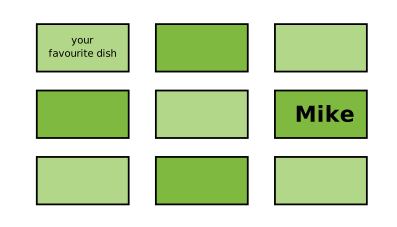
create cards with names of all participants + trainer
write cards with 6-8 questions (favourite food, comes from, reason to be here etc.)
turn one person card and a question card
the person drawn answers the question and draws next
play 10-20 rounds
Three things
summary |
participants establish common ground |
|---|---|
time |
10’ |
preparation |
0’ |
group size |
4-100 |
material |
- |
form pairs
ask participants to to find three things they have in common
let them talk for 3 minutes
each pair briefly reports what they found
In a big group, it is enough to ask participants to talk to their neighbors and ask for a few reports from different people.
Ball chain
summary |
participants repeat names |
|---|---|
time |
10’ |
preparation |
0’ |
group size |
6-20 |
material |
- |

Form a circle
throw a ball to each other and say from
<MY_NAME>to<YOUR_NAME>repeat until every participant had the ball 1-2 times
This method is good for a second introduction round, e.g. on a second day, when participants already know each other a little.
Guess who I am
summary |
participants guess things about each other |
|---|---|
time |
10’ |
preparation |
0’ |
group size |
5-15 |
material |
small paper cards |
share the cards
ask everybody to write down something about themselves, e.g. “I have 2 cats”
collect the cards, shuffle them and read each statement aloud
the participants guess who it is.
This is a good method if the group members already know each other – it does not make much sense otherwise. You need to formulate the task very clearly.
I used this game in starting a programming course in a first contact situation. It was my first course in English, and it was their first course in English. We were quite nervous at first, but the guessing helped to break the ice.
Skill matrix
summary |
participants assess their own expertise |
|---|---|
time |
15’ |
preparation |
10’ |
group size |
4-12 |
material |
board or spreadsheet |
Participants and teachers rate their expertise in 5 areas on a scale of 1-5, e.g.:
Python programming
data visualization
math + statistics
databases
Machine Learning
Collect the numbers on the board or an electronic table. The data can be used right away for a programming exercise on data structures, databases or plotting.
This is a versatile method that produces data that helps you to assess the situation. You can repeat the exercise at the end of the course and let students compare the data.
When participants know each other well
introduce yourself
collecting expectations is super important here
distrust your first impression
keep the introductions short
have participants introduce each other
let participants ask questions about you
Other methods
write 3 introduction questions on flipchart.
ask pairs to interview each other and then introduce their team partners
“museum”: ask participants to place one item from their bag on a tray and introduce them with it
short pantomimic introduction of a hobby or something they did recently (works if the group already knows each other)
participants introduce themselves briefly, but insert one lie. The others guess what was wrong (if the group knows each other, good primer for a lesson on conditionals)
divide the participants into smaller groups, each group introduces itself by drawing a poster (quicker way to introduce a big group)
let the group sort itself by programming experience (in the room)
Links
Teambuilding Exercises (in German)