How to handle participants under pressure?
Sometimes participants get nervous, frustrated or seem to be blocking themselves. In this chapter, you find a simplified explanation what might be going on and a few ideas what you can do.
A short tour of the brain
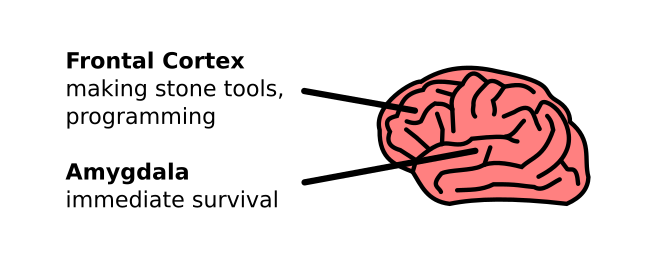
Our brain has two parts that are relevant for teaching:
The Frontal Cortex. This is a relatively new part responsible for intellectual tasks like making stone tools and programming. This is the part you want to be active in your course participants.
The Amygdala is an evolutionary old part hidden deeper in the brain. The Amygdala is responsible for everything related to survival. It becomes active in moments of danger and triggers flight-or-flight responses (imagine it speaks in capitals: “A TIGER! RUN!!!”).
There are not many situations where survival is threatened in a programming class. However, humans are social beings with core needs related to their belonging and status in a group. Whenever they perceive these core needs being threatened, the Amygdala is triggered as well and takes over control of the brain.
When that happens, the lesson is over for that person. You can’t learn programming if your brain tells you to run or defend yourself. You find a more detailed explanation of this model in Resilient Management by Lara Hogan.
What triggers the alarm response?
Students may feel their core needs being threatened by the following factors:
Personal stress – anything from a bad night, kids, illness, dentists, mortgages, stress at the workplace to an upcoming job interviews. Personal factors have in common that you cannot do much about them. Sometimes students want to talk about it, and you can listen, but most of the time it is none of your business.
Cognitive overload – this is probably the most frequent stress generator. There is too much content arriving in short time or the content is super difficult. A single lesson usually does not trigger an alarm response, but if the students are overloaded over a couple of days, they will be pushed towards the edge. Adults who are not used to learning are especially prone to that kind of stress. The sentence “this is easy” is one of the worst things you can say to an overloaded brain.
Unclear expectations – it is stressful for students if they do not know what to do. What are they supposed to work on? Do they have to finish all the exercises? Do they have to finish everything perfectly? Are they supposed to work on their own or cooperate? Presenting students multiple options what to work on increases their cognitive load as well.
Toxic course climate – any sort of dismissive behavior and speech, harassment and the like. This unfortunately happens in courses as well, which is why I think it is necessary to have a Code of Conduct and decisively act on it.
Being judged by others – a student who is in the comfort zone may enjoy a bit of competition. If they are not, comparing themselves to others generates stress. A teacher can reinforce that stress easily, e.g. by targeting questions to individuals or even mentioning the possibility of failing.
Greg Wilson says:
One of the fastest and surest ways to demotivate learners is to use language that suggests that some people are natural programmers and others aren’t. Guzdial has called this the biggest myth about teaching computer science, and backed this up by showing that people see evidence for a “geek gene” where none exists. …
(also see Demotivation on teachtogether.tech)
How to recognize that a student is under pressure?
The following statements are hints that a students old brain is about to take over:
“I am lagging behind”
“The others are much better”
“I am not good enough”
“I fear I will fail the course”
“I did not finish the exercise”
“I cannot finish the project”
“I do not want to present”
“I am not a developer”
Let’s look at what you can do as a teacher.
What can you do?
For all of the above resons, it should be clear that it is vital to create a climate where students feel psychologically safe. But what can you do to relief stress that is already there?
Here are a few strategies that help students to get their feet on the ground:
1. Teach less
do not squeeze more content in
focus on the essentials
leave away stuff (yes, I phrased that twice already, and it is really important)
reinforce structure – return to a concept map often
balance classroom time towards practical exercises
2. Find easy wins
re-state the minimal goal of the exercise / project
do easy exercises instead of challenging ones
work on open-ended problems (where any solution is great)
debug a code example together
3. Enhance psychological safety
ask fewer questions
favor round-robin questions over open questions
give participants time to discuss among themselves
make mistakes while coding and talk about them
4. Make room for cooperation
work on assignments in groups
team students up for projects
if possible, split the groups physically
find a simple next step together
5. Recap
Repeating things over and over is a key technique to build confidence in learners. Do:
state 3 things they should take from a lesson
go over the code of a previous lesson again
apply recap methods
review code together
watch a video